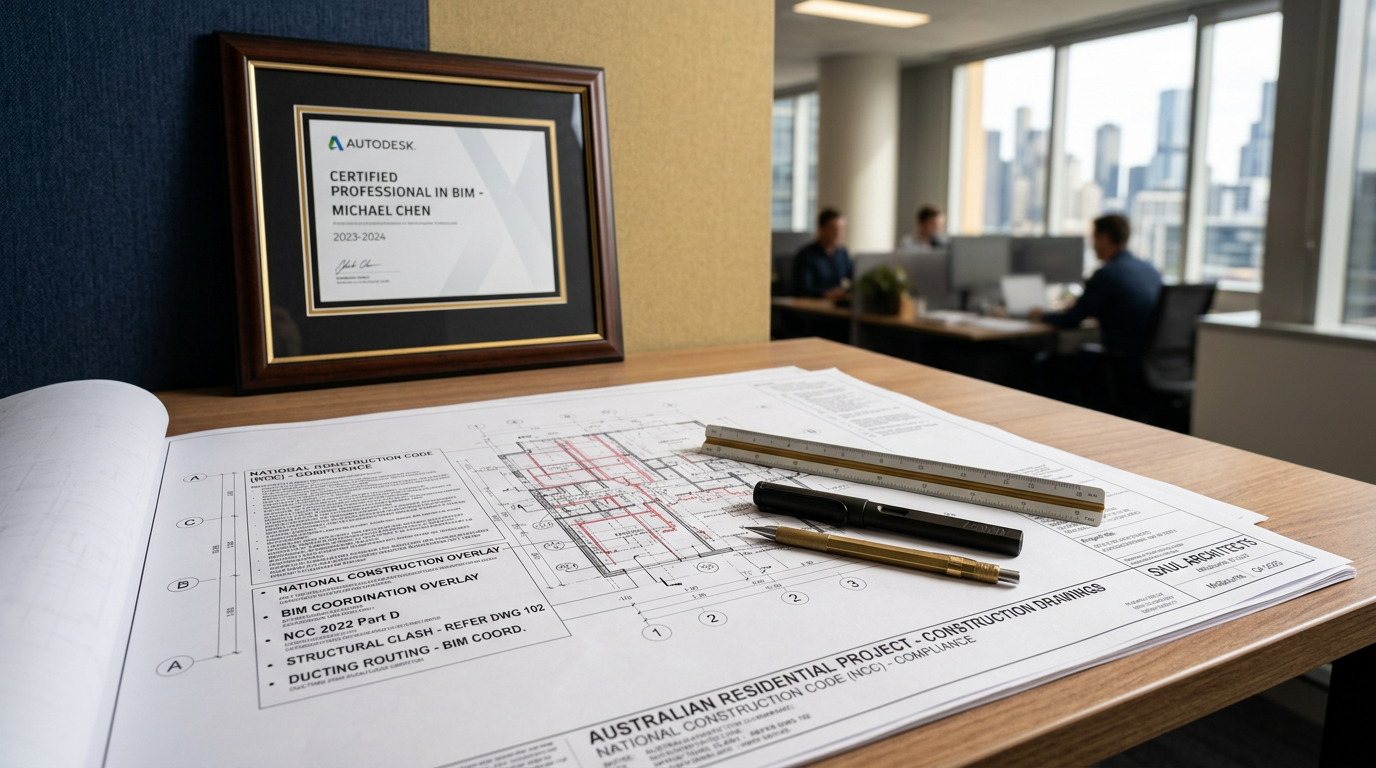
Here is a scenario that plays out regularly in Australian AEC practices. A firm reviews applications for a BIM Technician role and finds a strong candidate. The resume shows five years of Revit experience. The candidate holds an Autodesk Certified Professional credential. The portfolio looks clean. The interview goes well.
They make the hire. Three weeks in, the production drawings are coming back with the wrong title block format. The annotation styles do not match the firm's template. The consultant coordination files are named in a way that breaks the BIM Execution Plan. The first council lodgement submission gets kicked back because the drawing register does not meet the relevant state agency format requirements.
None of this reflects badly on the candidate's Revit ability. Their Revit ability is fine. The problem is that the Autodesk certification they hold was never designed to test any of what Australian firms actually need.
This is not a criticism of Autodesk's certification program. It is globally coherent and genuinely useful as a baseline measure of software proficiency. But it addresses the software, not the context. And in Australia, the context is where most offshore hires fail.
What ACU and ACP Actually Test
The Autodesk Certified User program targets entry-level competency. Candidates need roughly 150 hours of study. The exam covers fundamental tool operations across the relevant software, basic modelling workflows, navigation, and output generation. For Revit specifically, it tests family creation, view management, annotation, and basic coordination tasks. The certification is valid globally and recognised by most firms as confirmation that a candidate can operate the software at a foundational level.
The Autodesk Certified Professional sits above it. The recommended preparation is 400 hours minimum, extending to 1,200 hours for candidates approaching it from limited practical experience. The ACP covers more complex workflow scenarios, model management, project setup, and output configurations. For Revit, this includes advanced family parameters, worksharing, clash detection workflows, and production documentation generation.
Both credentials are maintained and updated by Autodesk. Both are genuinely respected. Neither is a shortcut qualification.
Here is the problem. The ACU and ACP are built around Autodesk's global curriculum, which references American standards and construction documentation practice as its default context. The exam scenarios, the template files used in training materials, the documentation examples in official Autodesk courseware: they are calibrated for a US construction market.
That means the candidate who earns their ACP through Autodesk's standard pathway has been trained against imperial units as the baseline, title block formats derived from US National CAD Standards rather than AS 1100 or AS/NZS 1100, CSI MasterSpec as the specification reference framework, the US International Building Code as the regulatory backdrop, and ANSI/AISC steel profiles and annotation conventions. None of that maps cleanly to Australian practice.
The Australian Context Gap
The gap between global ACP competency and Australian AEC readiness is not minor. It spans documentation standards, regulatory frameworks, specification systems, and the technical reference databases that Australian projects run on.
Drawing standards. Australian architectural and engineering drawings are governed by AS 1100 and the AS/NZS 1100 series. These cover drawing sheet formats, title block content, dimension annotation practices, drawing scales, and section identification conventions. The AS 1100.401 standard, which covers technical drawing for architecture, is specific about content requirements that differ materially from US or European equivalents. A technician trained exclusively on Autodesk's global curriculum will have produced drawings to a different standard and will not immediately recognise where their output diverges.
The National Construction Code. The NCC is the primary regulatory instrument governing building design and construction in Australia. It is a performance-based code that references Australian Standards for compliance pathways. It addresses structural, fire, accessibility, energy efficiency, and health requirements. An offshore technician producing documentation for an Australian project must understand how NCC compliance is demonstrated through drawing notation and schedules. BCA compliant wall ratings, NCC Section J energy documentation, and deemed-to-satisfy pathway notation are all ACP-invisible. They do not appear in global certification content.
NATSPEC. Australia's national specification system is NATSPEC, developed specifically for Australian practice and updated to reflect Australian Standards, products, and procurement environments. The global equivalent referenced in ACU and ACP training materials is MasterSpec or CSI format, both of which are American systems that structure specification sections differently, use different clause numbering conventions, and reference products and test standards that do not appear in Australian construction supply chains. A technician asked to coordinate drawings against a NATSPEC specification set on day one has no training basis for understanding the document structure.
Coordinate systems. Australian survey work operates on Geocentric Datum of Australia 2020, or GDA2020. The previous datum, GDA94, is still found in older project files. Understanding which datum a project is referenced to, how to set up project coordinates correctly in Revit, and how Australian registered surveyors deliver control point data is essential for anyone setting up or reviewing site models. This is entirely absent from Autodesk's global certification content.
Local pricing databases. Quantity surveying and estimating work in Australia uses Rawlinsons Australian Construction Handbook and Cordell Connect as primary cost reference databases. Neither of these appears in global ACP training. A candidate trained on US cost data has no foundation for understanding cost-check documentation that an Australian QS has produced.
The Documentation Problem
Australian construction projects produce documentation in specific formats that are shaped by state agency requirements, development application processes, and the administrative expectations of local government authorities.
Title blocks in Australian practice are not just branding elements. Most state public authorities publish mandatory title block specifications for submissions involving public infrastructure, health facilities, and educational buildings. The Queensland Government's QBCC-adjacent documentation standards, NSW government agency drawing templates, and Victorian Schools Building Authority format requirements all specify exact content, zone dimensions, and revision history formats. These are not optional. Non-compliance results in submissions being rejected or returned for correction.
Council lodgement formats vary by local government area, but most require a specific drawing register format, a consistent drawing numbering convention, and metadata that maps to the development application reference system. An offshore hire who has never been exposed to these requirements will produce output that needs to be reformatted before it can be submitted, which transfers the time cost back to the Australian team.
BIM Execution Plans on Australian projects are structured to include Australian-specific content. Project coordinate setup against GDA2020, naming conventions aligned with the project information management system, model breakdown structures that reflect Australian procurement packages, and clash detection responsibility matrices aligned with Australian delivery frameworks. An offshore BIM professional who has been credentialled against global ACU or ACP standards alone will not know what they are looking at in an Australian BEP.
Autodesk Construction Cloud, which is increasingly the common data environment platform for Australian projects, uses naming convention standards that typically follow conventions derived from AS ISO 19650 as adapted for Australian practice. The Australasian BIM Advisory Board has published guidance on this. ACU and ACP curricula do not cover AS ISO 19650 naming conventions at all.
What a Week-One Ready Hire Actually Needs to Know
A week-one ready hire for an Australian AEC firm is not just technically proficient in the software. They understand the practice context well enough to produce output that requires minimal correction and no re-education.
The specific competencies that ACU and ACP leave unaddressed include AS/NZS 1100 drawing standards including sheet formats, title block content requirements, north point and grid annotation conventions, revision notation, and the difference between first and third angle projection. They also include NCC compliance notation covering how to annotate wall fire ratings referencing NCC Volume One, how to show deemed-to-satisfy compliance in schedules and notation, and what constitutes adequate documentation for a building certifier.
NATSPEC document structure is another gap: how specification sections are numbered, what a worksection cross-reference looks like in a NATSPEC set, and how drawing notes coordinate with specification clause requirements. Australian title block formats, GDA2020 and project coordinate setup, Autodesk Construction Cloud AU conventions derived from AS ISO 19650, familiarity with Rawlinsons and Cordell, and state development application formats round out the list.
None of these appear in ACU or ACP content. All of them come up in the first month on an Australian project.
How the AEC Labs Certification Closes the Gap
The AEC Labs Foundation Certificate was built specifically to address the Australian context gap that global certifications leave open. It does not replace ACU or ACP. It validates what those credentials cannot cover.
The comparison is direct. ACU tests Revit software proficiency at a foundational level. ACP tests it at an advanced level. Neither covers AS/NZS 1100 drawing standards, NCC compliance documentation, NATSPEC specification structure, Australian title block formats, GDA2020 coordinate setup, AS ISO 19650 AU naming conventions, BIM Execution Plan AU format, Rawlinsons and Cordell familiarity, or state DA submission formats. AEC Labs Foundation covers all of them as core or assessment modules.
The certification is structured around 14 weeks of learning and assessment, running alongside existing work commitments. Assessment is not multiple choice. Candidates produce documentation outputs that are reviewed against actual Australian practice standards, including correct title block content, properly formatted drawing registers, and NCC-referenced notation.
Candidates who hold ACU or ACP can enter the AEC Labs program with software proficiency already established. The certification builds the contextual layer on top of that foundation. For candidates without ACU or ACP, AEC Labs includes software proficiency validation as a prerequisite assessment before the Australian context modules begin.
The result is a hire whose CV says "AEC Labs Foundation Certified" alongside their Autodesk credentials. For an Australian firm reviewing applications, that combination signals something the Autodesk credentials alone cannot: this person has been assessed against the specific standards and formats you actually use.
That is the gap. AEC Labs exists because no other certification body was filling it.
If you are assessing offshore candidates and relying on Autodesk credentials as your primary quality signal, you are making decisions on the software half of the picture. The other half is the context. See what the AEC Labs certification covers at our certification page.