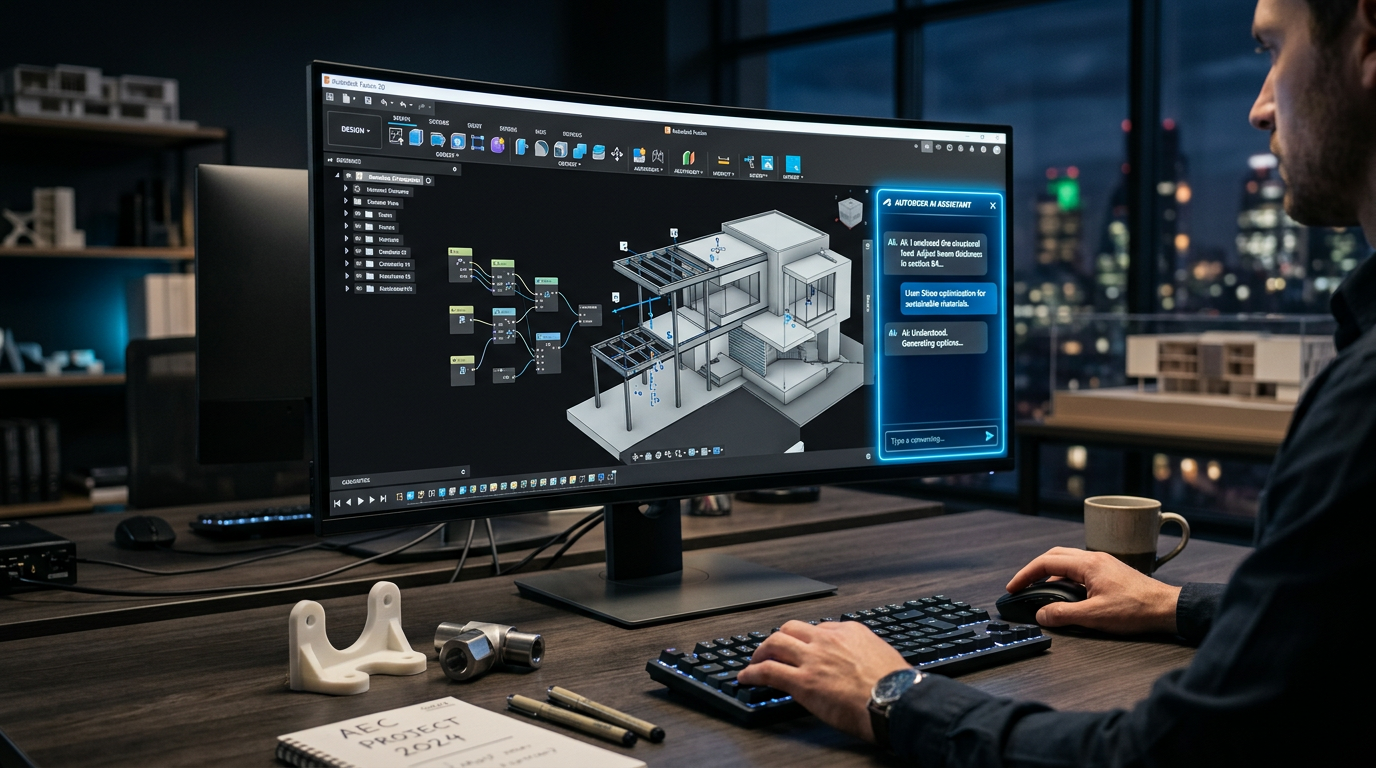
On April 28, 2026, Autodesk published a post on the Autodesk Platform Services blog announcing Claude MCP integration for Fusion 360. Engineers can now type natural language instructions and have Claude drive geometry inside the software.
That announcement received a fraction of the attention it deserves.
It is not a gimmick feature for demos. It is not a concept video. It is production-available functionality inside one of the most widely used mechanical and product design tools in the world, and it arrived in the same week that Trimble released an MCP server for SketchUp. Revit 2027 was already confirmed to ship with a native MCP server built in.
Three major AEC and design toolsets. One week. One protocol. The industry's relationship with AI-assisted workflows changed faster than most people in the sector have had time to process.
What MCP Actually Is
Model Context Protocol, or MCP, was developed by Anthropic. It is an open protocol that lets AI models like Claude connect to external systems, read their state, and take actions within them in a structured and controllable way.
The non-technical version: MCP is the thing that lets an AI assistant understand the context of a specific application, not just the text in a chat window.
Without MCP, AI tools in design software have mostly operated through workarounds. You copy data out of the tool, paste it into a chat interface, get a suggestion, copy it back. Or you use a plugin that runs a scripted workflow and hands off to an AI at specific decision points. The results have been useful but disconnected. The AI never really knew where it was in the design process.
With MCP, an AI can have persistent, live context about the model it is working with. It knows what geometry exists, what constraints are active, what the current design state is. When you give it an instruction, it is not guessing at your setup. It is working with real information about the actual model.
That is the technical distinction that makes April 28 significant. This is not AI-assisted documentation or a natural language search function on top of a library. This is AI with live context inside a design tool, able to act on that context in response to plain English instructions.
What Changes Inside Fusion
The Autodesk announcement describes Claude receiving natural language instructions and driving geometry within Fusion 360. The key clarification from Autodesk's own framing is important: execution stays inside Fusion. The AI assists, but the operator remains in control of the workflow.
In practical terms, this means a designer can describe a modification in plain language and have Claude interpret and execute that as a Fusion operation. Adjust the fillet radius on these edges to match the draft angle on the face above. Create an array of this feature at 15-degree intervals. Rebuild this sketch to enforce the symmetry constraint that the imported geometry broke.
Instructions that would previously require the designer to navigate menu trees, recall exact command names, and understand the precise parametric hierarchy of the model are now expressible in the language a designer naturally uses when thinking about design problems.
This is not a substitute for understanding how the software works. A designer who does not understand parametric modelling will not suddenly produce better models because they can use natural language. The AI does not make up for missing knowledge. But a designer who does understand the tool, and who can now express complex operations in the time it takes to say them, has a meaningfully different relationship with their own output capacity.
The speed effect compounds. A senior Fusion user who can describe the intent of a modification and have it executed correctly the first time is not just saving clicks. They are removing the cognitive overhead of translating design intent into software syntax. For complex operations across large parametric models, that overhead is not trivial.
The Week That Changed the Toolset
The Fusion announcement did not land in isolation.
The same week, April 28, 2026, Trimble released an MCP server for SketchUp. SketchUp is one of the most widely used early-stage design tools across architecture and construction. Its simplicity has always been part of its value. The MCP integration preserves that simplicity and extends it: designers can now describe what they want to model and have the AI execute it, which dramatically lowers the skill threshold for getting useful geometry out of the tool quickly.
Revit 2027, Autodesk's flagship BIM platform, ships with a native MCP server built in. That is not an add-on. That is Autodesk deciding that MCP-based AI integration is core functionality, not an extension. By the time Revit 2027 reaches broad deployment across the sector, MCP-connected AI workflows will be standard, not optional.
Three tools. One week. The direction is unambiguous.
The question is not whether AI-assisted workflows will become standard in AEC software. They already are. The question is how quickly the skills baseline in the sector adjusts to reflect that, and what happens to professionals whose capability map does not include working with these tools.
What This Means for Offshore AEC Talent
The Fusion MCP integration, the SketchUp server, and the Revit 2027 announcement collectively shift where the baseline sits for technically capable offshore AEC professionals.
This matters for offshore talent specifically because the skills verification and training challenge in offshore AEC hiring has always centred on a fairly stable set of competencies: software proficiency, documentation standards, regulatory context knowledge. Those competencies remain necessary. They are now insufficient on their own.
A BIM Coordinator who can build a clean Revit model but cannot navigate an AI-assisted coordination workflow is not at the same capability level as a BIM Coordinator who can do both. In 2024, that was a distinction that barely registered in hiring. In 2027, when Revit ships natively with MCP and firms are using Claude to assist with coordination clash resolution, model interrogation, and documentation output, it will be a material competency gap.
For Australian firms hiring offshore, this creates a second layer to the verification problem that already existed. The first layer was whether an offshore candidate understood Australian standards and context. The second layer is now whether they understand how AI-assisted tools change the way those standards get implemented in practice.
An offshore coordinator who has never worked in an MCP-connected workflow, who has never given natural language instructions to a design tool, and who has no mental model for how AI integration changes coordination processes, will need a different kind of onboarding than was required two years ago.
This is not a criticism of offshore talent. It is a description of a shift that is affecting everyone in the sector, Australian and international alike. The difference is that the offshore hiring decision involves a verification step that the local hiring decision does not, and that verification step now needs to include AI literacy.
Why Autodesk Certifications Do Not Cover This Yet
Autodesk's certification pathway, including the Autodesk Certified User and Autodesk Certified Professional qualifications, is built around the software as a standalone tool. Certification tests measure whether a candidate can operate Revit, AutoCAD, or Fusion to produce specified outputs using the software's native workflow.
Those certifications were designed before MCP-based AI integration was production-available in any of these tools. They have not yet been updated to reflect a workflow where Claude can drive geometry, where natural language instructions translate to model operations, or where AI-assisted coordination review changes how clash detection is approached.
This is not a criticism of Autodesk's certification program. Updating professional certification to reflect a technology shift of this pace takes time, and the industry is moving faster than any single credentialing body can track in real time. But the gap is real, and it is worth being honest about.
A candidate with a current ACP certification in Revit has demonstrated that they can build models and produce documentation within Revit's traditional interface. They have not demonstrated that they understand MCP workflows, can give effective natural language instructions to an AI design assistant, or know how AI-generated outputs need to be reviewed, validated, and integrated into a BIM coordination process.
That second set of capabilities is what separates a technically current professional from one whose skills profile reflects the toolset as it existed in 2023.
How AEC Labs Is Responding
AEC Labs is building AI literacy into every training track.
That decision was made before the April 28 announcements, but those announcements confirmed the direction. The question for any AEC training program in 2026 is not whether to include AI-assisted workflow competency. It is how quickly that competency can be embedded at a level that reflects how the tools actually work, not how a simplified overview describes them.
For the Foundation Certificate, this means covering MCP fundamentals in accessible terms: what the protocol does, how AI tools connect to design software through it, and what changes about how you work with the software when AI has live context rather than just a text input. Not a deep technical course on AI architecture. A practical working knowledge that lets a professional make intelligent decisions about when and how to use these tools, and what the outputs actually mean.
For Australian-context training, the AI integration layer matters because Australian documentation requirements, AS/NZS standards, and NCC provisions all need to be correctly interpreted when AI tools are assisting with documentation output. An AI assistant that drives Revit geometry is only as useful as the human's ability to evaluate whether that geometry satisfies the specific requirements of the project at hand. That evaluation requires context the AI does not have. Training offshore professionals to hold that context is still a human job.
The combination of Australian standards knowledge and AI-assisted workflow literacy is the competency profile that will define a productive offshore BIM professional in the Revit 2027 era. Not one or the other.
If you are thinking about how to keep your team's skills current as the toolset shifts, or how to evaluate whether an offshore candidate is actually ready for the way Australian firms are working now, our training pathway covers both sides of that picture.